


Avoidant/Restrictive Food Intake Disorder (ARFID) Worksheets
Avoidant/Restrictive Food Intake Disorder (ARFID) Worksheets

Less prep, more time with clients
Instant access, yours for life
Created by a registered psychologist
Couldn't load pickup availability
✅ Designed For
✅ Designed For
- Therapists, counsellors, psychologists, social workers and coaches
- Built for in-person and telehealth sessions
📦 What's Included
📦 What's Included
You will receive worksheet templates formatted for easy printing and fully compatible with all PDF fillable software.
📥 Accessing Your Product
📥 Accessing Your Product
Your files will be available immediately after purchase, both on the checkout page and via a download link sent to your email. Quick and hassle-free access.
📝 Product Description
📝 Product Description
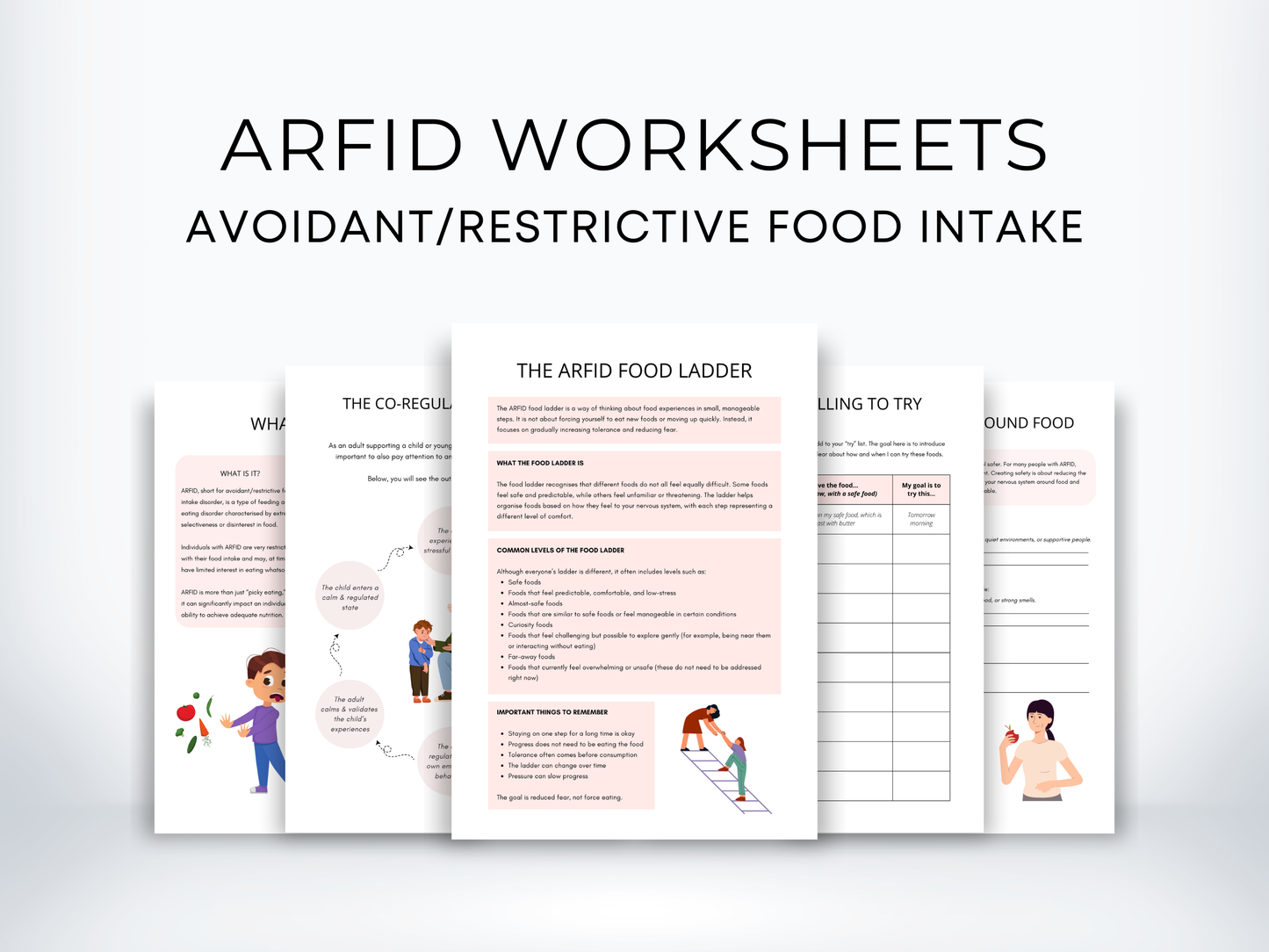
25 Page PDF Digital Download
Our ARFID (Avoidant/Restrictive Food Intake Disorder) therapy worksheets have been developed to support therapists and counsellors in understanding ARFID and providing compassionate, evidence-informed support for individuals experiencing restrictive or avoidant eating.
This resource is designed to help clients and families move away from shame, pressure, and misunderstanding, and toward safety, nervous system regulation, and gradual flexibility around food. It integrates psychoeducation, nervous system–informed frameworks, and practical therapeutic tools.
All information, exercises, and activities included in this resource are designed to be clear, supportive, and easy to integrate into therapy sessions and between-session work.
What do our ARFID therapy worksheets cover
This 25-page bundle includes psychoeducation, reflection tools, and structured worksheets to help clients and clinicians:
- Understand what ARFID is and how it differs from picky eating or weight-related eating disorders
- Review DSM-5 criteria and common myths surrounding ARFID
- Identify different ARFID presentations, including sensory-based, fear-based, and low-appetite presentations
- Explore how ARFID develops through sensory sensitivity, fear conditioning, appetite differences, and stress
- Understand the role of the nervous system and threat responses in food avoidance
- Learn why pressure and exposure-only approaches often increase distress
- Explore sensory processing differences and sensory overload in relation to eating
- Build interoceptive awareness around hunger, fullness, nausea, and internal body cues
- Understand fear conditioning and how avoidance is reinforced over time
- Develop emotional regulation and co-regulation skills related to food and eating
- Identify ways to create safety around food before introducing change
- Reframe progress in ARFID beyond eating new foods
- Use the ARFID food ladder to support gradual, non-forced exposure
- Map safe foods, “almost safe” foods, curiosity foods, and far-away foods
- Track food experiences and tolerance in a non-judgemental way
- Learn supportive language and approaches for caregivers and support people
Who are our ARFID worksheets for
Designed by a registered psychologist, this resource is ideal for psychologists, counsellors, therapists, dietitians, and allied health professionals supporting individuals with ARFID or restrictive eating patterns.
Suitable for use with children, adolescents, and adults, and particularly relevant for neurodivergent individuals, including those with autism, ADHD, sensory processing differences, anxiety, and trauma-related presentations. Appropriate for use across clinical, private practice, educational, and community settings.
What you can expect from our therapy tools:
- Structured exercises designed to support skill-building
- Based on established, evidence-informed therapy modalities
- High-quality resources with responsive support
- Practical, engaging, and easy-to-use designs
- Inclusive and relevant content for diverse clients
Further information on My Thriving Mind:
This is a digital product, available for instant download after purchase. The files are delivered in PDF format, optimised for both printing and to be online fillable.
If you have any questions or concerns prior to, or after purchasing this product please do not hesitate to reach out to us directly via our contact page.


From one therapist to another
Every resource is written by a registered psychologist and grounded in evidence-based practice. The structure is clear, the language is accessible for clients, and each page is formatted to use as it is, in person or over telehealth, with no reworking first.
- Written by a registered psychologist
- Evidence-informed, grounded in CBT, DBT and ACT
- Printable or fillable PDF, for in-person or telehealth
- Structured and ready to use in session
Why professionals choose us
Saved on weekly session prep
Streamlining their practice with our tools
sales worldwide
Looking for more than one topic?
This bundle is yours the moment you buy it. If you reach for resources across more topics, there are two easy ways to get the wider library.
Flexible monthly access
Download from the full library of 800+ worksheets across the core topics, with new resources added every month. A good fit if you dip in and out as your caseload changes, and you can cancel anytime.
See the membershipEverything, in one purchase
Own the complete library for life, including the family and children's resources and all three colour editions. A good fit if you would rather make one decision than choose topic by topic.
See the Whole Shop BundleCommon questions
How can these worksheets help me as a therapist?
They give you structured, clinically informed tools that cut your preparation time and support client engagement in session.
What mental health issues do your worksheets address?
We cover a wide range of presentations, including anxiety, ADHD, trauma and PTSD, boundaries, self-esteem, codependency, attachment, worry and overthinking, plus many more.
Are your worksheets based on specific therapy approaches?
Yes. Every resource is written by a registered psychologist and grounded in evidence-based approaches including CBT, ACT and DBT.
What topics and collections are available?
Our library spans the full range of clinical work. A few popular starting points:
Are the worksheets fillable and printable?
Yes. Each worksheet is a printable and fillable PDF, ready to use on paper or on screen, and compatible with all common PDF editors.
How will I receive my files after purchase?
As soon as your purchase is complete, your files are available for instant download on the confirmation page and are also sent to your email.
What if I have trouble accessing my files?
If you have any trouble downloading, please reach out via our contact page and we will sort it out promptly.